
The “Curiosity Gap” Strategy: How To Get More Email Clicks Without Clickbait


Do you want higher open rates from your emails? Do you try to write more compelling subject lines only to end up with higher spam rates?
If you want your readers to actually open your emails, read them and interact with them, you need to get them interested enough to click.
In this post, we discuss how to use curiosity gap to get more email clicks without resorting to clickbait.
Let’s get into it.
1. Learn what the curiosity gap is
The “curiosity gap” refers to the space between your email subject line and your email copy.
If your reader becomes captivated by your email’s subject line, they’ll become curious enough to open it, thereby closing the gap.
The phenomenon occurs in news apps and YouTube as well. If you read an article headline that piques your interest, you’ll become curious enough to click on it to find out what it’s all about. The same goes for YouTube videos.
Not every email has a curiosity gap. Your subject line might be captivating enough to grab your reader’s attention, but that doesn’t necessarily mean it makes your reader curious enough to click it.
This is why we’re going to discuss how to use this phenomenon to your advantage.
2. Understand that clickbait is bad for business
There is a difference between the curiosity gap strategy and clickbait.
While both strategies involve creating sensational headlines in order to attract clicks, their delivery is where they divert away from one another.
Clickbait is a practice in which a marketer over exaggerates their content in their headline, uses misleading language intentionally or outright lies in order to drive clicks.
When a user clicks the headline, the content is nothing like the marketer described.
In contrast, the curiosity gap strategy is a practice a marketer can use to excite their audience when they actually have a good piece of content to share. No clickbait needed.
They share a teaser in their headline to get their audience interested, then actually deliver on that headline in their content.
Clickbait is bad for marketing because it doesn’t deliver. It’s a cheap practice for spammers and scammers.
You might attract clicks with a clickbait strategy, but you won’t build an audience.
And if you keep tricking your audience with clickbait strategies, they’ll unsubscribe as fast as they can.
3. Know the different parts of an email
Your subject line isn’t the only bit of text your reader will see in their inbox. They’ll also see what’s known as your email’s preheader text.
Preheader text is the lighter bit of text that appears to the right of your subject line.

If you don’t fill it out, a preview of the first lines of your email will appear here by default. But most email marketing tools should allow you to edit your preheader text before you publish your email.
These are the two bits of text you should pay the most attention to since they affect how many clicks you’ll receive.
Here are other parts of an email:
- Opening line – The first sentence of your email
- Body – The main portion of text in your email. It’s the text that sits between your opening line and your closing statement
- Closing statement – The last sentence or paragraph in your email
- Call to action – The text you use on the interactive part of your email, usually a button
- Header – Not all emails have this, but it’s the element that appears at the very top of your email
- Footer – The element that appears at the very bottom of your email
While the subject line and preheader text affect open rates, the rest of these elements affect click-through rates.
4. Create a click-worthy email
The most important part of the curiosity gap strategy is ensuring your email copy delivers on what your subject line promised. To ensure that it does, make sure you spend time creating a click-worthy email.
At minimum, your email marketing strategy should involve several segments that you’ve organized your audience into.
Here are common segments email lists have:
- Customers and non-customers – This is for marketers who sell products and services. You use one segment (“Customers”) to label subscribers who have made at least one purchase from you and another segment (“Non-customers”) to label subscribers who haven’t
- Interest-based segments – Create different segments for the primary topics your brand covers. For example, a brand in the pottery niche could use “Ceramics,” “Polymer,” “Air Dry,” “Sculpting,” “Painting,” “Firing” and “Ideas”
- Skill-based segments – Create different segments that are based on how experienced your subscribers are in your niche, such as “Beginner,” “Intermediate” and “Pro”
The powerful part of segmentation is that when you create a new draft in your email marketing tool, you’ll be able to choose between sending your email to all of your subscribers or only specific segments.
This ensures your emails always reach subscribers whom you know are interested in their contents.
Once you work on that step, you can get to working on perfecting your email copy.
Most of your emails are probably promotional, which means they exist to advertise something, such as your latest post on your blog or social media page or a product you offer.
However, you should also create emails that don’t require your reader to go somewhere else to consume content.
This means they can get all that they need from the email itself.
Create emails filled with mini blogs, mini tutorials and quick tips to share with your audience, and try to create a balance between these types of emails and promotional emails.
Here a few quick tips for writing better emails:
- Write a strong opening line
- Use short paragraphs. Most of your subscribers will probably open your email on their smartphones
- Keep it short. Even if you’re sharing a tutorial, emails should be a very quick read
- Offer something for your reader in every email. This could be a discount, an announcement for something you know they’d be interested in, the tutorial itself, a tip, an exciting story you have to share, etc.
5. Use your subject line to pique your reader’s interest
This is the most important part of the curiosity gap strategy.
You know you have something exciting to share. Now, it’s time to let your reader know by creating a headline that captures their attention and gets them interested.
Here are a few examples and why they work.
The truth about [subject] no one wants to admit
Discussing controversial topics is a trick influencers use to generate more views and clicks.
In this particular example, you tease a controversial topic you’re going to discuss in your subject line but you don’t outright stay what it is. Your subscriber needs to open your email to reveal it.
There’s a lot of different ways you can tease such a discussion, but by using a phrase like “the truth about,” you let your subscriber know that you’re going to be discussing something a lot of folks don’t like to hear or admit.
The one thing I always do whenever I [niche-specific activity]
This email references a common activity in a specific niche, something almost every member of that niche does and will therefore be familiar with.
By using the phrase “the one thing I always do” instead of something like “how I [niche-specific activity],” you pique your subscriber’s interest by letting them know that there’s at least one thing you do differently from other people.
Still, they need to open your email to find out what that thing is.
[Act now] Up to half off on your favorites
This subject line does share a bit about what you’re offering by including the specific discount you’re offering.
However, it doesn’t explicitly state what you’re offering those discounts on.
Your reader needs to open the email to discover which products are categorized as your customer base’s “favorites.”
This subject line includes a call to action surrounded by brackets. This encourages urgency among your customer base.
It also uses the phrase “half off” in place of “50%” since using percentages in subject lines sometimes gets your emails labeled as spam.
Here are additional subject line examples that are designed to pique your audience’s interest but not share exactly what your email is about:
- The new and improved [product name]
- It’s here
- I broke a cardinal rule in [niche]
- I messed up…
- Drumroll, please…
You can also consider becoming a source of news in your niche by creating a regular email series that includes hot topics. If you do, use a news topic as a headline.
Real-world example of an email that satisfies the curiosity gap
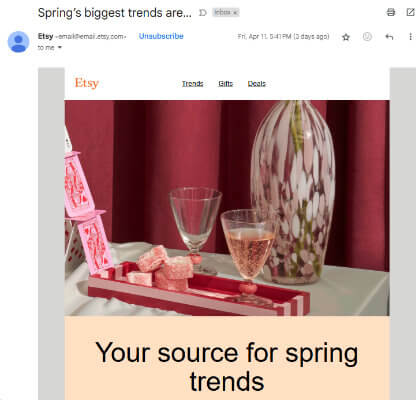
Subject Line: Spring’s biggest trends are…
Preheader Text: Open to find out!
This is a simple marketing email that lets creators know that Etsy sells the latest fashion and design trends for the season but uses an ellipsis to let the reader know that they need to open the email to discover what those trends are.
And Etsy does deliver.
The email consists of several trends you can click through and shop for.
This email also includes preheader text that plays off of the subject line. It instructs readers to open the email if they want to learn about the latest trends.
Final thoughts
Pumping out clickbait email newsletters and other types of content is easy.
But it leads to crushing disappointment and losing trust with your audience.
The curiosity gap strategy is different.
It’s all about getting your audience excited for a piece of content that delivers exactly what you promised.
And when you get it right, everyone wins.
You get clicks and your audience gets content worth clicking on.