
The Best Time To Send An Email In 2026 (Latest Industry Data)

If you want more people opening and clicking your emails, this is going to matter to you.
Because the truth is, it is not just what you send. It is when you send it.
Most people guess. Or they copy what someone else is doing. And that usually leaves a lot of opens and clicks on the table.
So I decided to dig into the data.
I went through the latest studies on email send times to see exactly when people are most likely to engage. Not opinions. Not theories. Real numbers.
In this post, I will show you what the data actually says about the best time to hit send.
And at the end, I will also show you a simple way to personalize send times for each subscriber so your emails can perform even better without adding extra work.
When is the best time to send an email?
The best time to send an email is during working hours on weekdays.
While vague, that’s the only meaningful conclusion we can draw from the data, as many studies have conflicting results.
In particular, Tuesdays and Thursdays may be the best days to send emails.
As for time, engagement tends to peak around 9 AM to 12 PM on weekdays, though there is also an ‘evening bump’ at around 6 PM.
While useful, it’s important to remember that these are just general guidelines.
In reality, the best time to send an email will vary for every sender. It all depends on your industry and audience.
For instance, B2B businesses may see best results during working hours when professionals are active, whereas B2C brands may get more opens and clicks during weekends and evening hours when consumers can check their personal emails at leisure.
Later, I’ll show you how to find the best time to send emails for your specific audience. But first, let’s take a closer look at the latest studies…
8 studies on the best times to send emails (and what they found)
Below, I’ve summarized the findings of eight of the latest (and most authoritative) studies into email send times.
If you’re short on time, you can just read the highlights in the table below.
| Study | Best days to send emails | Best times to send emails |
| MailerLite | Monday | 3 PM to 7 PM |
| Moosend | Thursday | 8 to 9 AM |
| Sendgrid | ~ | 8 to 9 AM (on Black Friday weekend) |
| Brevo | Tuesday, Thursday | 10 AM to 3 PM |
| Neil Patel | Tuesdays, Wednesdays, Thursdays | 9 AM to 12 PM |
| HubSpot | Tuesday | 9 AM to 12 PM |
| Omnisend | Tuesdays, Fridays | 2 PM, 5 PM, 8 PM |
| GetResponse | Tuesdays | 4 AM to 6 AM |
MailerLite
MailerLite analyzed over a million email marketing campaigns sent through their platform last year to try to identify the optimum times to send emails.
That’s a huge amount of data.
They found that sending emails on weekdays is generally more effective than on weekends due to higher overall engagement.
And while email marketers tend to favor Thursdays and Fridays, the day of the week that generates the most opens is actually Monday (51.9%), followed closely by Tuesday (51%).
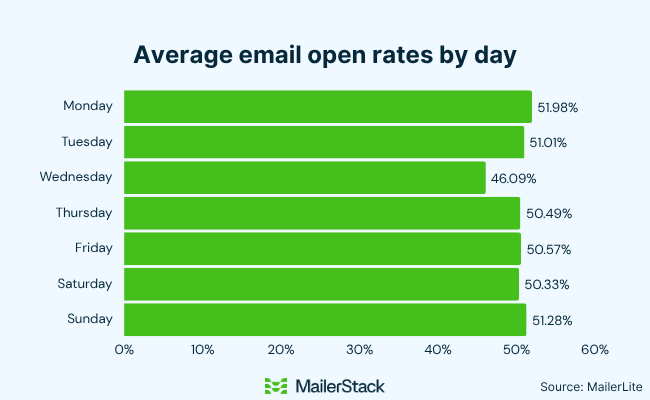
The study also found that the best time to send emails was between 3 PM and 7 PM (local time zones) on weekdays and around 9 AM on weekends.
Key takeaway: For best results, send emails mid-to-late afternoon on weekdays, and in the early morning on weekends.
Moosend
Moosend analyzed over 10 billion emails sent through their platform.
According to that analysis, emails sent on Thursdays generated the highest open rates, making this the best day to send emails, while Tuesday was the second-best day.
Saturday was the worst day to send emails by open rate, followed by Sunday, concurring with MailerLite’s findings that weekdays outperform weekends.
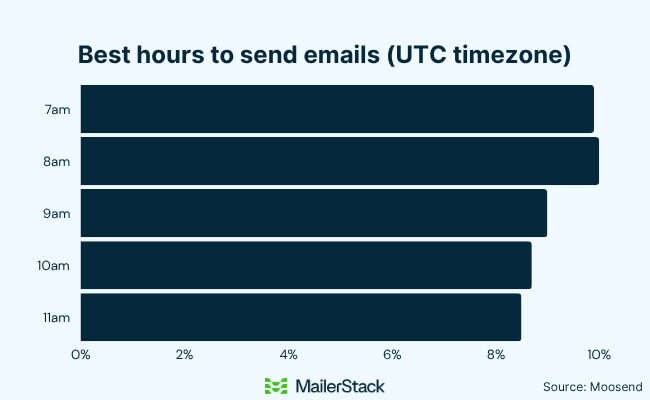
Moosend found that the best time of day to send emails overall is 8 to 9 AM, but engagement stays relatively high until around 6 PM, after which point open rates begin to decline.
Key takeaway: For best results, send emails in the morning on weekdays. Thursdays between 8 and 9 AM perform particularly well. Avoid sending emails on weekends, in the late evening, and at night.
Sendgrid
Sendgrid analyzed campaigns on their platform to figure out the best time to send emails during holiday events.
They found that the peak send time during Black Friday and Cyber Monday was 7 AM, but peak opens occurred between 8 AM and 9 AM.
Likewise, they found that the peak send time during Memorial Day weekend was 7 AM, but that open times varied so substantially that they couldn’t find any statistically significant time that recipients were most likely to open them.
More generally, Sendgrid advises against sending emails at the top or bottom of the hour, or at 15, 30, or 45 minutes past the hour.
This is when most marketers send emails, which can lead to ISP backups and late deliveries. Instead, they recommend sending emails at more unusual times (e.g., 7, 21, or 33 minutes past the hour).
Key takeaway: Send emails around 8 to 9 AM during commerce events/holidays like Black Friday for maximum opens. Avoid sending emails at popular time blocks (e.g., 8:00, 8:15, 8:30) and send at odd times instead (e.g., 8:01, 8:13, 8:27)
Brevo
Brevo studied its user data, looking at emails sent from the top ecommerce companies, to figure out which send times lead to maximum engagement.
They found that 10 AM is the most popular send time globally, and that the overall best time to hit send is between 10 AM and 3 PM (working hours) on Tuesdays and Thursdays (for opens) or Wednesdays (for clicks).
What’s more, weekdays account for the vast majority of email engagements—85% of the total weekly open volume and 95% of the weekly click volume.
They also broke down the results by industry. The table below illustrates their findings:
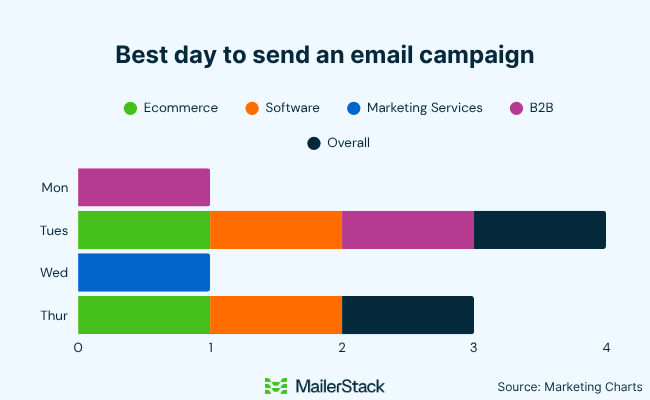
As you can see, the exact best time/day to send an email varies by business type. For instance, ecommerce businesses see most engagement at 10 AM, while NGOs get better results at 3 PM. However, optimum times fall somewhere in the mid-week (Tuesday to Thursday) between 10 AM and 3 PM across industries.
Key takeaway: For best results, send emails between 10 AM and 3 PM during mid-week days (Tuesdays, Wednesdays, Thursdays). Consider your industry and audience to further optimize send times.
Neil Patel
Neil Patel analyzed 1.46 billion emails sent over the course of a year.
The results showed that the best time to send an email is between 9 AM and 12 PM, while the best days to send are Tuesdays, Wednesdays, and Thursdays. Engagement stays relatively high in the early afternoon to early evening, too, but begins to drop off significantly after 6 PM.
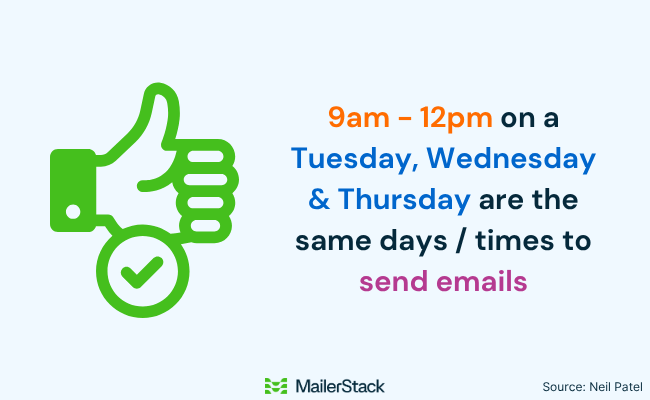
The worst time to send an email was found to be 9 PM to 3 AM, and the worst days to send were Saturday and Sunday.
What makes this study particularly noteworthy is that it analyzed emails from 83 different websites, rather than a single email service provider’s dataset (like most other studies).
As a result, the findings may provide a more representative and well-rounded view of general email engagement trends.
Key takeaway: For best results, send emails between 9 AM and 12 PM on Tuesdays, Wednesdays, or Thursdays. Avoid sending emails after 9 PM and on weekends.
HubSpot
HubSpot conducted a small-scale survey of 150+ marketing and advertising professionals in the US to find out when marketers think the best time to send an email is.
The majority of the survey participants said emails sent between 9 AM and 12 PM (31%), or 12 PM to 3 PM (26%), generated the highest engagement, making this the best time to send an email.
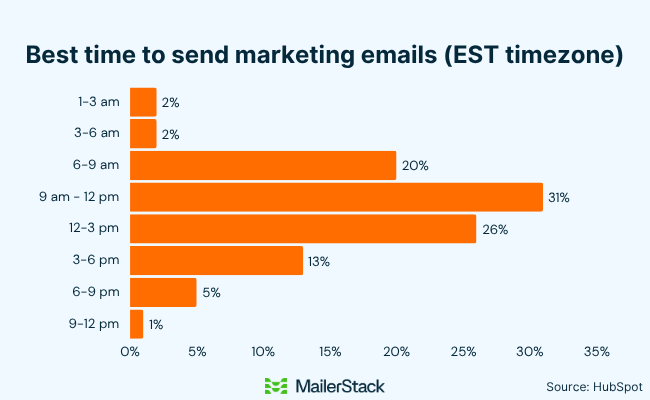
Only 1% of marketers said emails sent from 9 PM to 12 AM generated the highest engagement, making this the worst time to send an email.
The best day to send an email, according to the survey, is Tuesday (27%), followed by Monday (19%). And the worst days are Sunday (4%) and Saturday (5%).
Keep in mind that HubSpot’s study relies on the ‘wisdom of the crowd’ to draw meaningful conclusions. In other words, it only tells us what most people think the best/worst time to send emails is.
Interestingly, though, it looks like the findings of this survey align with the findings of most of the email engagement analyses we’ve looked at, reinforcing the results.
Key takeaway: Most marketers believe 9 AM to 3 PM on a Tuesday is the best time to send an email. Late at night and on weekends is widely thought to be the worst time to send an email.
Omnisend
Omnisend analyzed customer engagement patterns to determine when emails performed best for open rates, clicks, and conversions.
They found that the best days to send emails are Tuesdays and Fridays—emails sent on these days get consistently more opens and conversions, and higher clickthrough rates.
As for time, they found three times at which engagement peaks: 2 PM, 5 PM, and 8 PM.
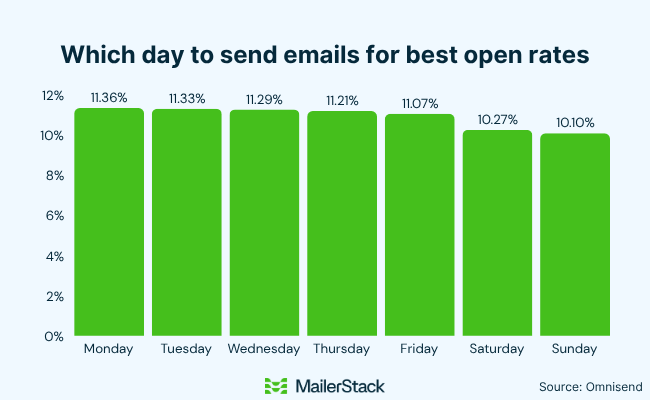
Omnisend is also one of the only platforms that considered days of the month in its analysis. It found that open rates peak on the 10th and 24th of the month, clickthrough rates peak on the 2nd and 26th, and conversion rates peak on the 1st and 30th.
This is likely due to pay cycles. Many employees get paid on the first or last day of the month, so it makes sense that conversions would peak on these days.
Likewise, clicks peak towards the start and the end of the month as users become more receptive to marketing emails around pay day.
Key takeaway: For best results, send emails at around 2 PM, 5 PM, or 8 PM on Tuesdays and Fridays. Email clicks and conversions are highest at the beginning and end of the month.
GetResponse
GetResponse conducted one of the largest email marketing campaign studies, analyzing over 4.4 billion email messages sent from senders with at least 500 contacts over the course of a year.
They found email open rates were highest at 4-6 AM, making this the best time to send an email. They also identified another evening bump at around 5-7 PM.
Inboxes at both of these times are typically less cluttered, making it easier to stand out. Plus, many recipients check their inboxes after waking up or finishing work, which is why these send times perform so well in terms of open rates.
However, click-through rates and click-to-open rates were found to be highest between 11 PM and 12 AM, suggesting that email recipients may be more active and likely to engage with the content of emails late at night.
As for days, weekdays significantly outperformed weekends in all key metrics. There was found to be little difference between individual weekdays, but Tuesdays had the overall highest open and click-through rates.
Key takeaway: For best results, send emails in the early morning hours (4-6 AM) or around work finish times (5-7 PM) on weekdays (particularly Tuesday). While open rates remain low late at night, click-through rates peak around midnight.
How to find your best time to send emails
The studies we’ve looked at offer valuable insights into general email habits, but the data can only take you so far.
The truth is, every audience is different. What works for one business might fall flat for another.
Your subscribers are unique. They have their own routines, preferences, and behaviors—and that means your optimal send time is unique, too.
That’s why the most effective approach isn’t to blindly follow the averages, but to test, analyze, and discover what works best for your list.
In this section, I’ll show you exactly how to do that using proven, practical methods.
The easy way
The easiest way to find the best times to send emails to your audience is to use an email marketing tool that can calculate it for you.
That way, you don’t have to worry about optimizing send times and can focus your attention on more important stuff (like writing compelling subject lines)
With MailerLite, you can activate Smart Sending to ensure every email you send lands in each recipient’s inbox when they’re most likely to engage.

It uses AI to analyze your past campaigns, considering factors like previous timing, opens, and clicks, to figure out when each subscriber in your list is most likely to engage with your emails. Then, it puts together a personalized sending schedule for each individual subscriber.
So instead of manually scheduling each email you create, you can just choose a date and hit the Smart sending button, and MailerLite will automatically send an email to each recipient at the optimal time within those 24 hours (in their own time zone).
And what’s cool is it continually analyzes your campaigns to learn more about your subscribers’ interactions and improve its accuracy over time. So the more emails you send, the more data you feed it, and the better it gets.
The hard way
If you don’t want to use a smart sending tool like MailerLite, the other option is to figure out your own best time to send manually.
Here’s how to do that, broken down into three steps.
Step 1: Consider your audience
The first step is to consider what you know about your audience. The more you understand the people you’re trying to reach, the easier it’ll be to zone in on the best time to reach them.
Here are some questions to consider:
- Are you targeting businesses or consumers? The best time to send an email varies between B2B and B2C. It’s easier to reach business customers during working hours, while consumers may be more likely to engage outside of working hours.
- What does their daily routine look like? And how might that impact how they engage with your emails? For instance, if you’re sending marketing emails for a fast food chain, you probably want to capitalize on the lunch rush. So, find out when your target audience typically takes their lunch break and send emails just before then.
- What are their demographics? Different demographics have different email engagement patterns. For instance, younger audiences might check emails late at night on their phones, while older professionals might be more responsive early in the morning during work hours.
- When are they ready to convert? If the goal of your email campaigns is to drive sales, it’s best to send emails when your target audience is most likely to buy. That might be at the end of the month when they’ve just received their paycheck, or late at night when they’re bored and more likely to do some online shopping.
- When did they sign up for your list? If possible, export your email list data to find out when your existing subscribers registered. This is a good way to get a general idea of when they’re most likely to engage with emails.
Step 2: Experiment with different send times
Your analysis of your audience should have given you some idea of when they may be most likely to engage with your emails. The next step is to test those assumptions out.
And the only way to do that is to experiment with different send times.
Depending on the email marketing platform you’re using, you may be able to set up A/B tests in which you directly compare two different send times of the same email and evaluate the results.
If not, just schedule emails at different times throughout the month and then review your analytics at the end of the month to find out which emails saw the highest open and click rates.
Step 3: Continually analyze and optimize
Take what you learned in step two and feed that back into your email marketing strategy.
If you noticed that emails sent at certain times of day perform better, schedule more emails at those times going forward to confirm, but leave room for further experimentation.
A good rule of thumb is to follow the 80/20 rule. Send 80% of your emails at what you currently think is the best time to send, but experiment with other time slots with the remaining 20%.
Then, regularly review your analytics to compare performance and use those insights for further send time optimization as needed.
Bonus tip: Split your list into groups
Most email marketing tools offer list segmentation tools, so you can group subscribers into buckets and then personalize your emails for each group separately.
This is a good way to further optimize your send times. For instance, you might notice that some subscribers engage with emails more during weekdays, whereas others engage with emails more during weekends.
In that case, you can segment your list into a weekday group and a weekend group, and send emails on different days to each of them to maximize your opens and clicks.
Keep experimenting to discover new segments and use that to personalize your email send times even further.
Final thoughts
So here’s the bottom line.
If you look at the data as a whole, most emails perform best during normal weekday working hours. In particular, Tuesdays and Thursdays between 9 AM and 12 PM tend to see strong engagement.
But that does not mean there is one magic send time that works for everyone.
Different studies show different peaks throughout the day. And your results will always depend on your business, your audience, and what you are actually sending.
That is why relying only on general benchmarks can hold you back.
The smartest move is to let your own data guide the decision. Use an email marketing tool like MailerLite that automatically figures out the best send time for each subscriber based on their past behavior. Or test different send times yourself and track what gets the best opens and clicks.
Do that, and instead of guessing, you will know exactly when to hit send.
Related reading: